Let’s Put it on the Table, ep. 1: Where the Idea Was Born

Introducing a new podcast series by the Macro-Development Research Initiative, from the Graduate Institute in Geneva. “Let’s put it on the table” will discuss development-related topics that are not receiving enough attention.

Our guest for this episode is Alejandro Castro, one of the founding members of Club Macro, the Club de Macroeconomía UCV, the student analysis group of macroeconomic policy at Universidad Central de Venezuela. Club Macro was the seed that later shaped the idea for our international initiative: The Macro-Development Research Initiative.

Subscribe to the series on Spotify for more episodes and follow the initiative on social media as @The_MDRI on Twitter and Instagram

Featuring: Clara Danbakli and Manuel Leon, with Michelle Olguin
Guest: Alejandro Castro
Music: Showcase me by Ahjay Stellino 
Illustration: MDRI

Big shout out to Geneva International, the Podcast initiative at the Graduate Institute of International and Development Studies in Geneva, for their help and support.

Note: This pilot was recorded via Zoom, so please forgive us for the audio quality and internet related problems.

Let’s make a talk show!

Geneva Intl. is always looking for new talent, and a couple of weeks ago we found it among the students at the Graduate Institute. During our welcome day event we put all of these people in front of a microphone and asked them to make a talk show from scratch. Here’s the result! 

If you too would like to take part in this initiative, email us at Gisa.podcast@graduateinstitute.ch and tell us what you’d like to do. 

Music: Travel by JayJen & tubebackr promoted by Free Stock Music
Illustration: GISA


Follow Geneva Intl. on Instagram

Let’s chat with a recent graduate from our Institute, John!

This podcast is a short and fun conversation with a recent graduate of MIH (Masters in International History student) on life before, during and after the Graduate Institute. It features questions on what John’s first impression of Geneva was, what his advice would be to students coming in this year and some light trivia questions to reflect on his graduate student experience. Hop on to this easy and light conversation and take away one student’s perspective on a few aspects of student life at the Graduate Institute!

Guest: Phasawit Jutatungcharoen (also called John/Jun)
Host: Samhita Bharadwaj

More about John: John completed his quarantine in Thailand and has documented his journey and experience on his youtube channel.

Music: Beanbag Fight by Scanglobe from the Free Music Archive (CC-BY-NC-SA 4.0)

Introducing “Pop Theory” (ep. 01)

For the very first episode in this Pop Theory podcast, we will be discussing *drum roll* images, or pictures, or whatever you want to call them. We see them every day, they scroll past us on screens, they take up most of the free spaces around us but do you ever really notice them? Well, we do, and then we analyze them, and then we overanalyze and introduce jargon to make us feel better about ourselves as serious scholars. 

Joining us today as Co-hosts we have:

  • Paras Arora: Second year Master’s candidate and Hans Wilsdorf scholar at the Department of Anthropology & Sociology. Paras has wide-ranging research interests and has most recently conducted ethnographic fieldwork in New Delhi, India around questions of gender, disability and care work. In the past, he has presented his research on Delhi-based feminist, collectives and archivists’ practices of image production and circulation at the Universities of Cambridge, Amsterdam, Istanbul, Singapore, and Delhi. As the UNESCO Aladdin Youth Ambassador for Peace and Intercultural Dialogue, Paras has also worked closely on sexuality, international migration, and religion.
  • Samhita Bharadwaj: First Year Masters Student at IHEID in MIA, specializing in Environment and Sustainability, with a minor in Global Health. A background in Psychology in her Bachelors, she’s aware of the use of images and visual media on cognition and perception.

Presented by: Michelle Olguin Fluckiger

Music: Tu connais Babar by Mocke (CC By-NC-SA)

For more Pop Theory, please visit https://anchor.fm/pop-theory/ or subscribe to the dedicated feed through your podcasting app of choice.

Health, Intl. ep. 3: Spanish Flu and the Uses of History with Covid-19

In the third episode of the Health, Intl. podcast, Samhita and Thomas discuss the Spanish flu of 1917-1920, a global pandemic that could provide analogies for the current Covid 19 crisis. They discuss how the Spanish flu has been often forgotten in history, and how the flu compares and contrasts with today’s pandemic.

Listen now.

Episode notes

Featuring: Samhita Bharadwaj & Thomas Gidney

Music: What I Learned from Your Mother, by Elephant Funeral (CC By-NC-ND 4.0)

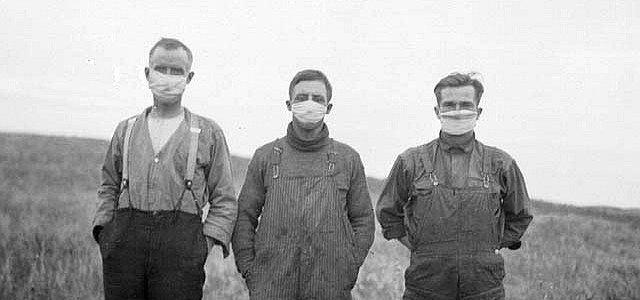
Picture: Men wearing masks during the Spanish Influenza epidemic / Hommes portant un masque durant l’épidémie de grippe espagnole, 1918. Library and Archives Canada, PA-025025, CC By 2.0.

Sources:

Spinney, Laura. Pale Rider: The Spanish Flu of 1918 and How It Changed the World. 1 edition. New York: PublicAffairs, 2017.

Crosby, Alfred W. America’s Forgotten Pandemic: The Influenza of 1918. Cambridge University Press, 2003.

Oxford, JS, A Sefton, R Jackson, W Innes, RS Daniels, and NPAS Johnson. “World War I May Have Allowed the Emergence of ‘Spanish’ Influenza.” The Lancet Infectious Diseases 2, no. 2 (February 1, 2002): 111–14. 

Cheng, K. F., and P. C. Leung. “What Happened in China during the 1918 Influenza Pandemic?” International Journal of Infectious Diseases 11, no. 4 (July 1, 2007): 360–64. https://doi.org/10.1016/j.ijid.2006.07.009.

Langford, Christopher. “Did the 1918–19 Influenza Pandemic Originate in China?” Population and Development Review 31, no. 3 (2005): 473–505. 

Oxford, John S., and Douglas Gill. “A Possible European Origin of the Spanish Influenza and the First Attempts to Reduce Mortality to Combat Superinfecting Bacteria: An Opinion from a Virologist and a Military Historian.” Human Vaccines & Immunotherapeutics 15, no. 9 (September 2, 2019): 2009–12.