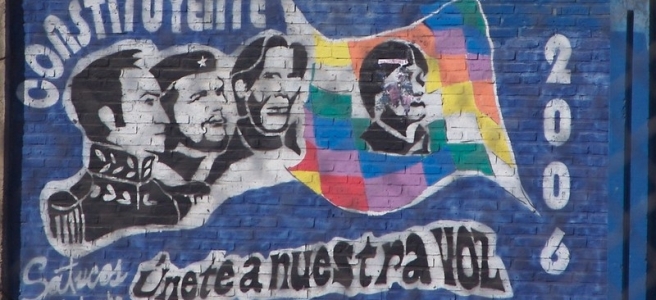
Book of the Week: “The rise of Evo Morales and the MAS”, by Sven Harten

Evo Morales is one of the world’s most controversial political leaders. His story is extraordinary: poor shepherd-boy, persecuted coca grower, self-professed admirer of Ché Guevara, hero of the anti-globalization movement, and first indigenous president of modern Latin America.

The story of the social movement turned political party he is a part of — the Movimiento Al Socialismo (MAS) — is also exceptional: originally founded as a splinter of an ultra-right party, it was given as a gift for the coca growers after they had been banned several times for spurious reasons to register their own party, and went on to become an irresistible force for indigenous rights in Bolivia.

In this insightful and revealing book, Sven Harten explains the success of the MAS and its wider consequences, showing how Morales has become the symbol for a new political consciousness that has entailed de-stigmatizing indigenous identities.”

Publisher: London, Zed Books, 2011
Call number: 920(84)MOR HEIA 74764


Illustration (cropped): Constituyente 2006, by A. Davey (CC By 2.0)
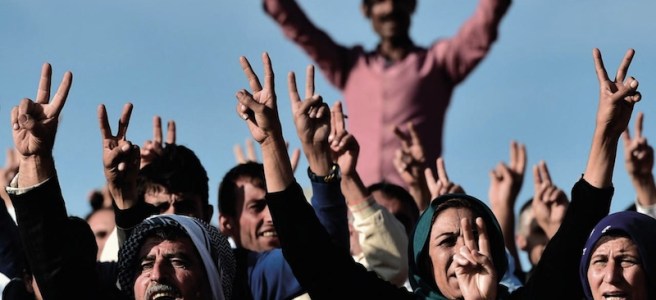
Book of the Week: “The Kurds of Northern Syria: Governance, Diversity and Conflicts”

By Harriet Allsopp and Wladimir van Wilgenburg (I.B.Tauris, 2019), ISBN 9781838604455

“Based on unprecedented access to Kurdish-governed areas of Syria, including exclusive interviews with administration officials and civilian surveys, this book sheds light on the socio-political landscape of this minority group and the various political factions vying to speak for them.
The first English-language book to capture the momentous transformations that have occurred since 2011, the authors move beyond idealized images of Rojava and the Kurdish PYD (Democratic Union Party) to provide a nuanced assessment of the Kurdish autonomous experience and the prospects for self-rule in Syria. The book draws on unparalleled field research, as well as analysis of the literature on the evolution of Kurdish politics and the Syrian war. You will understand why the PYD-led project in Syria split the Kurdish political movement and how other representative structures amongst Syria’s Kurds fared. Emerging clearly are the complex range of views about pre-existing, current and future governance structures.”

Available under call number 323.1(569.1), HEIA 125534 


Illustration from book cover

Book of the Week: “Poor economics: a radical rethinking of the way to fight global poverty”, by Esther Duflo and Abhijit Banerjee

The new recipients of the Nobel Prize in Economics upend the most common assumptions about how economics works in this gripping and disruptive portrait of how poor people actually live.

“Why do the poor borrow to save? Why do they miss out on free life-saving immunizations, but pay for unnecessary drugs? In Poor Economics, Abhijit V. Banerjee and Esther Duflo answer these questions based on years of field research from around the world. This book offers a radical rethinking of the economics of poverty and an intimate view of life on 99 cents a day. Poor Economics shows that creating a world without poverty begins with understanding the daily decisions facing the poor.”

Publisher: Noida: Random House India, 2011
Call Number: 337.2 HEIA 84548

Publisher: New York: PublicAffairs, 2011
Call Number: 337.2 HEIA 75424

French translation: Repenser la pauvreté
Editions du Seuil, 2012
Call Number: 337.2 HEIA 84811


Original illustration (cropped): Esther Duflo, Pop!Tech 2009, Camden, ME, by Kris Krüg, CC-By-SA 2.0

Livre de la semaine : “Je travaille, donc je suis : perspectives féministes” sous la dir. de Margaret Maruani

Central dans tous les processus sociaux, le travail ne saurait aujourd’hui être étudié indépendamment des relations de genre.

Dès l’après-Seconde Guerre mondiale, l’accès au travail rémunéré a été au cœur des revendications des mouvements féministes occidentaux. En parallèle, cette question de l’activité laborieuse a constitué un champ privilégié pour les travaux de recherche pionniers sur les femmes. En ce début de XXIe siècle, marqué par une « crise » économique de long terme, une augmentation de la précarisation et un chômage endémique liés aux politiques néolibérales, l’analyse de la place des femmes et des hommes sur le marché du travail reste un passage obligé pour comprendre, beaucoup plus largement, les formes nouvelles de la domination masculine.

Rassemblant une trentaine d’auteur·e·s issu·e·s de différentes disciplines et pays, Je travaille, donc je suis propose d’éclairer, dans une perspective internationale et à travers des objets d’étude novateurs, les débats contemporains articulant genre et travail. Cet ouvrage s’appuie sur une hypothèse forte : le travail est une fenêtre sur le monde social – sur ses hiérarchies, ses tensions, mais aussi sur ses transformations – et l’analyse de la place des femmes et des hommes sur le marché du travail doit rester au cœur de toute réflexion sur l’émancipation des femmes.


Editeur : Paris : La Découverte, 2018
Cote : 331.4 HEIA 122172

Book of the Week: “Europe in the international order” by Roman Kuźniar

The rise and fall of Europe’s aim to rebuild its position in global politics after the Cold War.

With success in the unification of Europe and the subsequent deepening and enlargement of its integration, the Union set itself the ambitious task of becoming a global power, even a superpower.

However, starting with the first decade of the XXI century, we have witnessed a rapid erosion of the international position of Europe (the EU). The author carefully analyses the causes of the EU’s failure in pursuing the role of European representative, Europe thereby pretending to the role of one of three world powers. Besides cultural and demographic trends, the author identifies the main factors leading to this failure: the divergent interests of individual European powers, their incapacity to act in a geopolitical context and the rapid erosion of Europe’s civilizational identity.

The rapid decline of Europe’s international position threatens the appearance of a new and bipolar global arrangement together with the further marginalisation of Europe.


Publisher: Berlin ; Bern : Peter Lang, 2018
Call Number: 327.91 HEIA 123903