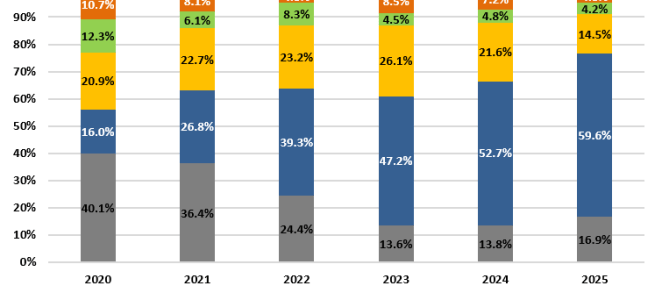
Since 2021, the Graduate Institute has agreements with major publishers that make it easier for researchers to publish open access (OA) articles. They have taken advantage of this opportunity and the proportion of OA articles has risen sharply. But a detailed analysis shows that the path taken may be unsustainable, and that most researchers are still neglecting simple ways to make their research accessible.
What colour is your open access?
Using the Unpaywall database, we can produce a detailed analysis of our publications. Instead of just distinguishing between open and paywalled articles, we can now also have data on the “colours” of OA articles, gold, green, bronze and hybrid.
Gold open access articles are published in fully open access journals, with or without publication fees. Diamond journals are a subset of Gold OA titles that do not charge any fees to authors or readers. They are usually funded by universities, libraries or research centres.
Green open access is a simple way of making paywalled scholarly articles accessible to everyone. Journal articles are written by researchers who are paid by universities or research centres, not by the journals that publish them. Authors are usually allowed to upload their accepted manuscript (i.e. ready for publication, with all corrections, but without the journal’s layout) to a non-profit repository such as the Graduate Institute repository. Some services such as Unpaywall or the Open Access Button then make it easy for interested readers to find these manuscripts whenever they don’t have access to the paywalled version.
The main issue with green OA is the embargo period imposed by most publishers. They sometimes require a delay of 6 to 24 months before a publication is made available on a repository, which conflicts with most funders’ policies. Although some publishers have reduced ore even eliminated these embargoes, they remain a significant barrier. This is why the Swiss National Science Foundation requires its grantees to use the rights retention strategy to publish their accepted manuscript without an embargo. Ask your librarian how to include this provision in your future submissions to paywalled journals.
Bronze articles are freely available, but do not have a clear open licence. Open access articles should always mention a Creative Commons licence, which clearly states the permissions granted to the users. Bronze articles are technically free, but their status may change at the discretion of the publisher, who may decide to put them behind a paywall, which is why they are not considered “open access”.
Hybrid journals are subscription journals that publish some of their articles open access, provided the authors pay (usually very high) APCs (Article Processing Charges). These APCs are typically covered under our “Read and Publish agreements”, making them invisible to researchers. However, this system creates an inequality between researchers (usually based in rich countries) who benefit from these agreements and those who don’t. These contracts are extremely expensive, since publishers are private companies that want to maintain their large profit margins. Negotiations are difficult, and in some cases the publisher’s unacceptable conditions cause no-deal situations, as is currently the case with Sage and Springer.
The challenges ahead
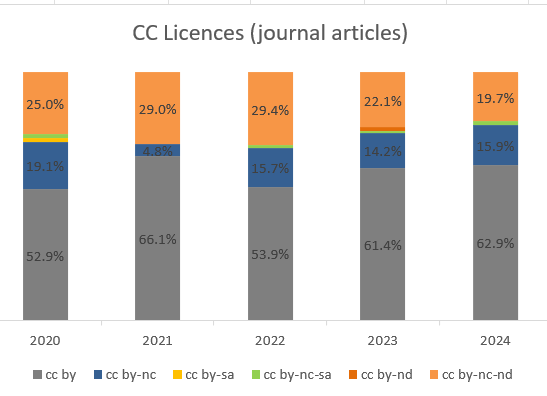
Regarding licenses, the trend is clear: the CC BY (Attribution) license, which protects the author(s) while offering broad reuse options to reuse the article, is the most widely used. This is also due to the fact that this license is mandatory for grantees of the Swiss National Science Foundation.
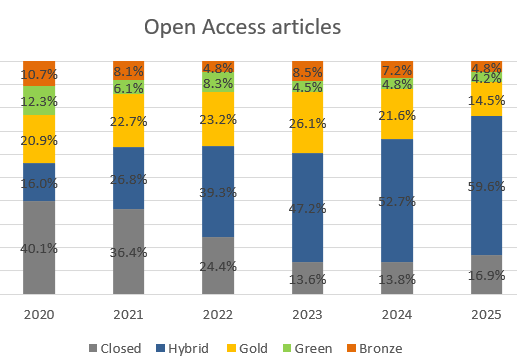
However, our barometer indicates that publishing in hybrid journals remains the primary route to publish open access for our researchers. It also shows that after a sharp decline in the early years of this decade, the proportion of closed-access articles has now plateaued. This stagnation is due to several factors: journals not covered by our agreements, article types excluded from these agreements or cases where a Graduate Institute researcher is a co-author alongside a corresponding author who lacks funding options.
This explains why national associations such as Swissuniversities (which designs the Swiss national OA strategy) increasingly see hybrid OA as a dead end. Read and publish agreements were originally intended to be “transformative”, leading to the transformation of hybrid journals into full OA journals, but we have to acknowledge that this is not happening and new solutions must be studied.
Among these solutions, diamond and green open access appear particularly interesting and cost-effective. Several projects are currently underway to develop sustainable diamond journals platforms and/or funding schemes. The Graduate Institute is a partner in one such initiative, CODOA. Green open access also represents a win-win opportunity for researchers. However, many remain skeptical, likely due to a lack of information. The open access policy currently under discussion at the Graduate Institute aims to make green open access standard practice for our researchers.

