Most funders include Open Access mandates in their contractual conditions. Why are they doing this, and what can grantees do to comply with these mandates? OA specialist Catherine Brendow explains.
The goal of mandates
The main aim of these mandates is to make sure that research financed by public funds is accessible to the public for free, and not locked behind paywalls. Funders generally make it compulsory for grantees to publish their research in open access (OA) journals or to make a version of their articles available in OA repositories.
The Swiss National Science Foundation (SNSF) requires its grantees to make the results of their research open access, either by publishing in an open-access journal or by placing them in an open-access repository such as the Graduate Institute repository, without any embargo. Journal articles must generally be published under a CC BY licence.
Option 1: the Gold road
You can publish in a pure open-access journal, with or without article processing charges (APC). The SNSF can finance your APC to publish in these if required. The Directory of Open Access Journals is a “white list” of peer-reviewed open-access journals which can be trusted.
Some journals are considered hybrid, meaning they are subscription-based journals in which some articles can be made open access after payment of an APC. The SNSF does not finance APCs for hybrid journals. This is due to a strong suspicion that hybrid journals might practice “double dipping”, by pocketing APCs without reducing subscription prices. Furthermore, hybrid journals often charge higher APCs than pure OA journals.
Option 2: the Green road
Most publishers of subcription-model journals will let you publish a version of your article on your institution’s repository. Usually, the version you will be able to archive will be the postprint, aka author’s accepted manuscript (AAM). This is the revised manuscript of the article after peer-review acceptance, but before type-setting and formatting for publication. While it will look different from the journal version, its contents should be identical.
Publishing this version on our repository without an embargo period will fulfill your funder’s OA mandate, and will also make the OA version of your article findable easily through Unpaywall and other similarly useful tools, as our repository metadata is harvested by them.
Who owns your research?
After the thrill of getting your article accepted by a very reputable subscription-based journal, you may find yourself in an uncomfortable situation: what if the journal refuses to let you share your AAM without an embargo but your funder requires it? This question, of course, should be avoided by selecting a journal that does adhere to your funder’s policy, but here we are.
If we stop and consider what is really at stake, the key question is: who owns your research? You and your co-authors? The organisations that funded it? Or the journal that manages the peer review process, formats your article, manages the layout, and archives it on its servers? While journals provide essential services, is this a good reason to give up your copyright for free and let them own your research?
Most funders disagree, including cOAlition S members such as the SNSF – meaning that Switzerland-based researchers should care about their policies. cOAlition S believes that the owners of the research are the people who produce it: the researchers themselves, who also have a duty towards the public, and that they should not give away their copyright for free just to publish in a reputable journal. This is why their grantees must apply the Rights Retention Strategy:
“On submitting the manuscript, researchers reserve the right to make it freely available with immediate effect under a CC-BY licence, citing their commitment to the SNSF”.
Applying the rights retention strategy enables researchers to publish their accepted manuscript without an embargo, even if the publisher objects. Some actually include provisions stating that funded research may follow funder mandates in all cases. It also puts some pressure on publishers to improve their open access policies and get rid of excessive embargo periods.
Do you want to know more? Read Catherine’s open-access libguide and feel free to ask your librarians for advice!
You can also join Catherine’s presentation on OA publishing on Monday 20 October 2025 at 14:00.
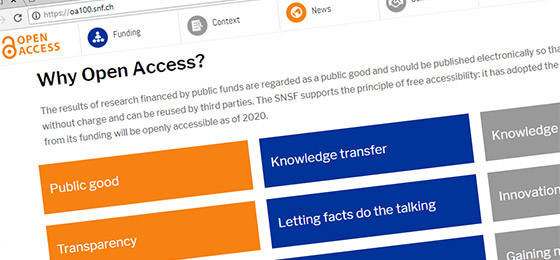
Illustration: SNSF
 Geneva Graduate Institute Library Blog
2 thoughts on “Research funders and open access mandates”