
Google Scholar is the go-to search engine for anyone looking for scholarly content. It offers the same convenient and familiar interface as Google, as well as options that can be useful to researchers. Here is how to use it properly.
The Internet is full of scholarly content in a variety of formats and quality. Google Scholar is an efficient way to retrieve peer-reviewed articles, theses, preprints and conference proceedings. Note that not everything is available through Google Scholar, other tools such as the swisscovery catalogue and our A-Z Databases list can help you complete your research.
Do not forget to check the credibility of resources linked through Google Scholar before using them! It is necessary because Google Scholar is not a curated, controlled database: its content is harvested automatically.
Once you have found relevant results, Google Scholar allows you to:
- Copy a formatted citation in a variety of styles, including Chicago-style
- Export bibliographic data (BibTeX, RIS) for use with reference management software
- Find other works that cite a reference
- Find full-text versions of articles where they are freely available
- Set up a library connection to highlight titles available through your institution’s subscriptions
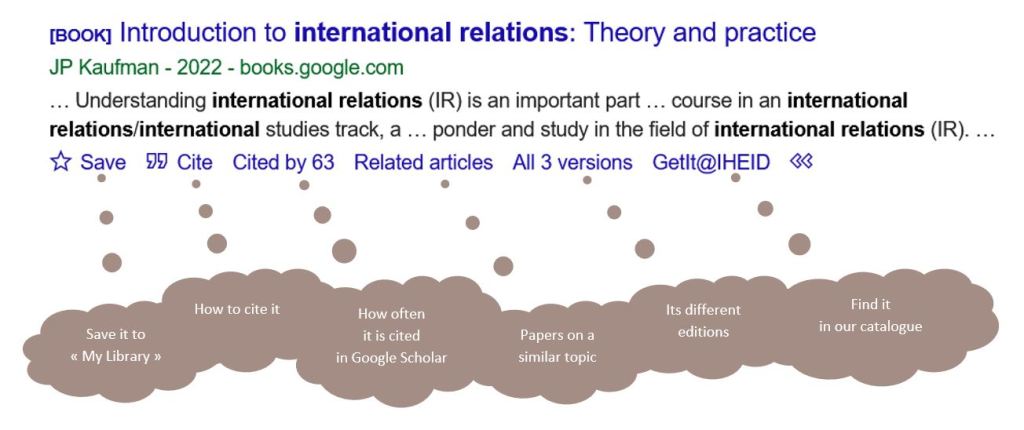
The number of citations to an article is an important factor in the ranking of Google Scholar results. This favours publications from sources with a high impact factor, which are frequently cited or linked to on the web. On the other hand, new papers have what is called a citation lag and appear in the results list after older, more frequently cited papers.
In addition, documents published in languages other than English are relegated to positions that make them virtually invisible.
Finally, Google Scholar Metrics provide you an easy way to quickly gauge the visibility and impact of recent articles in scholarly publications by viewing journal rankings and ratings. As an author, you can create a public profile that appears at the top of the results list when your name is searched, with the option to receive notifications when your work is cited.
The world of Google Scholar is vast and full of treasures, as well as pitfalls to avoid. This updated guide will give you tips and tricks to make your research more efficient.
 Geneva Graduate Institute Library Blog