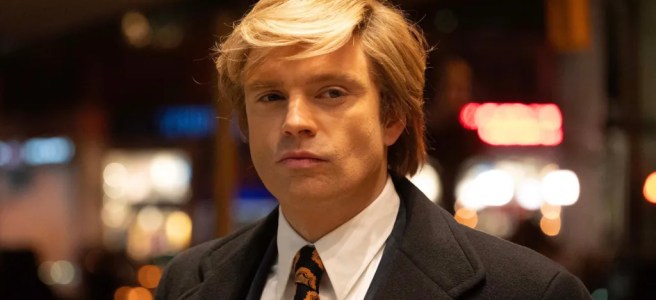
“The apprentice” by Ali Abbasi: how Trump became Trump

Ruthless lawyer of New York, Roy Cohn spots a timid blond in a private club. Inviting him to his table, he makes the acquaintance of Donald J. Trump.

Read more: “The apprentice” by Ali Abbasi: how Trump became Trump

In the seventies, Manhattan is nothing but a rotting apple. Sex, drugs, poverty, and violence haunt its long avenues. An aspiring real estate developer, Trump dreams of restoring its splendor and prestige. Through lawsuits, blackmail, and corruption, he will succeed, under the guidance of his new mentor.

Jeremy Strong’s piercing gaze as Cohn leaves no doubt about who he has chosen for his succession. Like a bird of prey, the champion of McCarthyism has found his target: an immature greenhorn puking his first vodka shots. But “Donnie Boy,” a young man scorned by his father, shows boundless ambition. The devil wears oversized suits, and a Faustian pact is sealed with three golden rules: always attack, deny everything, and claim victory even in defeat. A future president is born.

In a convincing reconstruction—yellowed image, worn grain—the diabolical duo works its dastardly magic, pulling off a staggering power shift. The narrative takes its protagonist seriously, even as it repeatedly points out his weight and baldness issues. In the role of the ugly duckling, Sebastian Stan is impressive, morphing through the physique, gestures, and grimaces of a failed Robert Redford lookalike into the political figure we know today. Damn morality, good, evil, and truth. Growing in confidence, the beast unchains itself from its master and turns his principles against him. The thirsty vampire gradually drains his mentor’s vitality. A homophobic homosexual, Roy Cohn fades away, struck down by AIDS. The Shakespearean tragedy sparkles gaudily and leaves a bitter aftertaste… Today, this “killer machine” driven by ego holds the fate of the world in his hands. And it is no longer fiction.


The apprentice by Ali Abbasi can be (re)discovered on DVD at the Library:
Call number: 2.2 TRU 4
Film guide
Film collection
Don’t have a DVD player? Borrow a portable DVD player from our services.

“The Seed of the Sacred Fig” by Mohammad Rasoulof: Woman, Life, Freedom

Iman, an honest man, is appointed as an investigator for the Tehran Revolutionary Courts. This should delight his wife and two daughters. However, following the death of Mahsa Amini—arrested by the police for wearing an inappropriate headscarf—riots erupt in the capital.

Read more: “The Seed of the Sacred Fig” by Mohammad Rasoulof: Woman, Life, Freedom

This new job will finally get them the four-room apartment they’ve been waiting for, the dishwasher they’ve been dreaming of, and a few rungs up the social ladder. But it also involves signing hundreds of warrants for the summary execution of arrested activists.

Rasoulof’s genius lies in his ability to blend the contemporary history of an entire country with its direct consequences for a typical family. One of the most striking scenes contrasts images of police violence with the controlled discourse of state television. For once, social networks tell the truth.

The pivotal character is Najmeh, the mother, torn between her children’s growing rebellion and her loyalty to her husband. Corrupted by his position of power, the man of integrity retreats into silence, paranoia, and violence—even subjecting his loved ones to arbitrary interrogation and imprisonment.

Given the clandestine conditions in which the film was shot, one might have feared it would be shaky and unsteady. It is nothing of the sort. The camerawork in the apartment provides scenes of rare beauty, such as the care a wife shows to the face of the man she loves, or the blood from buckshot pellets spilling onto a white, pristine bathroom sink.

Although long, the film manages to keep us on edge, veering from intimate drama to thriller, with chases and horrific elements as the executioner hunts his prey. In Iran, the snowy labyrinth of the Overlook Hotel is replaced by an abandoned troglodyte town.

Condemned to exile—like some of his actresses—the filmmaker has produced a strikingly topical testimony right under the noses of the mullahs. The title evokes the fig tree, a sacred plant whose seeds colonize and suffocate a host to spread. If we want to be optimistic, we could see this as a symbol of hope.

“On my school notebooks, on my desk and on the trees, on the sands of snow, I write your name. And by the power of a word, I regain my life. For I was born to know you, to name you… Freedom.”
Translated from Paul Éluard’s Liberté


The Seed of the Sacred Fig (Dane-ye anjir-e ma’abed) by Mohammad Rasoulof can be (re)discovered on DVD at the Library:
Call number: 7.0 SEE
Film guide
Film collection
Don’t have a DVD player? Borrow a portable DVD player from our services.