Health, Intl. ep. 3: Spanish Flu and the Uses of History with Covid-19

In the third episode of the Health, Intl. podcast, Samhita and Thomas discuss the Spanish flu of 1917-1920, a global pandemic that could provide analogies for the current Covid 19 crisis. They discuss how the Spanish flu has been often forgotten in history, and how the flu compares and contrasts with today’s pandemic.

Listen now.

Episode notes

Featuring: Samhita Bharadwaj & Thomas Gidney

Music: What I Learned from Your Mother, by Elephant Funeral (CC By-NC-ND 4.0)

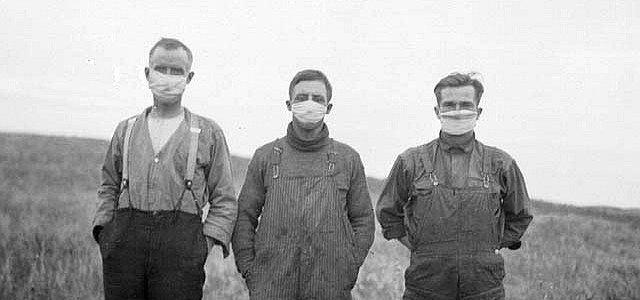
Picture: Men wearing masks during the Spanish Influenza epidemic / Hommes portant un masque durant l’épidémie de grippe espagnole, 1918. Library and Archives Canada, PA-025025, CC By 2.0.

Sources:

Spinney, Laura. Pale Rider: The Spanish Flu of 1918 and How It Changed the World. 1 edition. New York: PublicAffairs, 2017.

Crosby, Alfred W. America’s Forgotten Pandemic: The Influenza of 1918. Cambridge University Press, 2003.

Oxford, JS, A Sefton, R Jackson, W Innes, RS Daniels, and NPAS Johnson. “World War I May Have Allowed the Emergence of ‘Spanish’ Influenza.” The Lancet Infectious Diseases 2, no. 2 (February 1, 2002): 111–14. 

Cheng, K. F., and P. C. Leung. “What Happened in China during the 1918 Influenza Pandemic?” International Journal of Infectious Diseases 11, no. 4 (July 1, 2007): 360–64. https://doi.org/10.1016/j.ijid.2006.07.009.

Langford, Christopher. “Did the 1918–19 Influenza Pandemic Originate in China?” Population and Development Review 31, no. 3 (2005): 473–505. 

Oxford, John S., and Douglas Gill. “A Possible European Origin of the Spanish Influenza and the First Attempts to Reduce Mortality to Combat Superinfecting Bacteria: An Opinion from a Virologist and a Military Historian.” Human Vaccines & Immunotherapeutics 15, no. 9 (September 2, 2019): 2009–12. 

E-book of the Week: “Pandemics and Emerging Infectious Diseases: The Sociological Agenda”, by Robert Dingwall, Lily M. Hoffman and Karen Staniland

“Infectious disease pandemics are a rising threat in our globalizing world. This agenda-setting collection provides international analysis of the pressing sociological concerns they confront us with, from cross-border coordination of public health governance to geopolitical issues of development and social equity. Focuses on vital sociological issues raised by resurgent disease pandemics. Detailed analysis of case studies as well as broader, systemic factors. Contributions from North America, Europe and Asia provide international perspective. Bold, agenda-setting treatment of a high-profile topic.”

https://ebookcentral.proquest.com/lib/graduateinstitute/detail.action?docID=1222575

Publisher: John Wiley, 2013.

E-book of the Week: “Succeeding with your Master’s Dissertation: A Step-by-step Handbook”, 3rd ed. by John J. Biggam

“This book provides in-depth guidance on how to complete your dissertation, thus meeting the needs of students eager for practical assistance in this common place, but challenging, mode of assessment.”

https://ebookcentral.proquest.com/lib/graduateinstitute/detail.action?docID=1920721

Publisher: McGraw-Hill Education, 2014

E-book of the Week: “The World Health Organization: A History”, by Marcos Cueto, Theodore M. Brown and Elizabeth Fee

“According to its Constitution, the mission of the World Health Organization (WHO) was nothing less than the ‘attainment by all peoples of the highest possible level of health’ without distinction of race, religion, political belief, economic status, or social condition.

But how consistently and how well has the WHO pursued this mission since 1946? This comprehensive and engaging new history explores these questions by looking at its origins and its institutional antecedents, while also considering its contemporary and future roles. It examines how the WHO was shaped by the particular environments of the postwar period and the Cold War, the relative influence of the US and other approaches to healthcare, and its place alongside sometimes competing international bodies such as UNICEF, the World Bank, and the Gates Foundation.

The authors re-evaluate the relative success and failure of critical WHO campaigns, from early malaria and smallpox eradication programs to struggles with Ebola today.”

Publisher: Cambridge University Press, 2019
https://www.cambridge.org/core/books/world-health-organization