E-book of the Week: “China’s Strategic Multilateralism: Investing in Global Governance”, by Scott L. Kastner, Margaret M. Pearson and Chad Rector

“China sometimes plays a leadership role in addressing global challenges, but at other times it free rides or even spoils efforts at cooperation. When will rising powers like China help to build and maintain international regimes that sustain cooperation on important issues, and when will they play less constructive roles? This study argues that the strategic setting of a particular issue area has a strong influence on whether and how a rising power will contribute to global governance. Two strategic variables are especially important: the balance of outside options the rising power and established powers face, and whether contributions by the rising power are viewed as indispensable to regime success. Case studies of China’s approach to security in Central Asia, nuclear proliferation, global financial governance, and climate change illustrate the logic of the theory, which has implications for contemporary issues such as China’s growing role in development finance.”

https://doi.org/10.1017/9781108695725

Publisher: Cambridge University Press, 2018

Print version: 327(51) HEIA 124018

Loan Service Reopening on Monday!

The Library’s loan desk will reopen for the Graduate Institute community only (students, staff and researchers) on Monday, 11 May.

The loan desk will be accessible from Monday to Friday, 09:00-17:00. Your Graduate Institute student/staff card will be required to enter the building.

To borrow documents, you must first reserve them by using our new form. They will be stored for pickup at the loan desk on the next working day.

The interlibrary loan service will also reopen with limited service (depending on ILL activity in partner libraries).

The reading room remains closed, and access to the printers/copiers is impossible. If you have a personal locker in the Library, you will be allowed to access it to retrieve your items.

E-book of the Week: “Sovereign Debt Crises: What Have We Learned?”, ed. by J.P. Bohoslavsky and K. Raffer

“There is an obvious need to learn more about why some countries succeed and others fail when dealing with debt crises. Why do some sovereign debtors overcome economic problems very quickly and at minor human rights costs for their people, while others remain trapped by debts for years struggling with overwhelming debt burdens and exacerbating economic problems and human suffering? This book analyzes fourteen unique or singular country cases of sovereign debt problems that differ characteristically from the ‘ordinary’ debtor countries, and have not yet received enough or proper attention – some regarded as successful, some as unsuccessful in dealing with debt crises. The aim is to contribute to a better understanding of the policy options available to countries struggling with debt problems, or how to resolve a debt overhang while protecting human rights, the Rule of Law and the debtor’s economic recovery.”

https://doi.org/10.1017/9781108227001

Publisher: Cambridge University Press, 2017

Print version: 336.3 HEIA 120441

Illustration: book cover

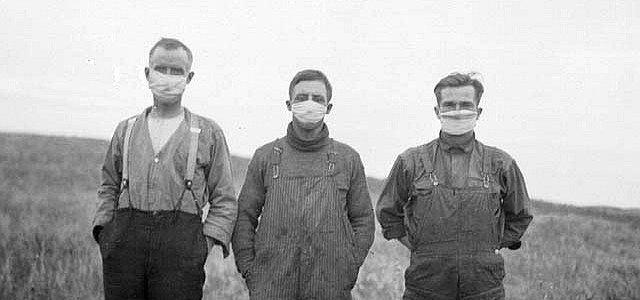
Health, Intl. ep. 3: Spanish Flu and the Uses of History with Covid-19

In the third episode of the Health, Intl. podcast, Samhita and Thomas discuss the Spanish flu of 1917-1920, a global pandemic that could provide analogies for the current Covid 19 crisis. They discuss how the Spanish flu has been often forgotten in history, and how the flu compares and contrasts with today’s pandemic.

Listen now.

Episode notes

Featuring: Samhita Bharadwaj & Thomas Gidney

Music: What I Learned from Your Mother, by Elephant Funeral (CC By-NC-ND 4.0)

Picture: Men wearing masks during the Spanish Influenza epidemic / Hommes portant un masque durant l’épidémie de grippe espagnole, 1918. Library and Archives Canada, PA-025025, CC By 2.0.

Sources:

Spinney, Laura. Pale Rider: The Spanish Flu of 1918 and How It Changed the World. 1 edition. New York: PublicAffairs, 2017.

Crosby, Alfred W. America’s Forgotten Pandemic: The Influenza of 1918. Cambridge University Press, 2003.

Oxford, JS, A Sefton, R Jackson, W Innes, RS Daniels, and NPAS Johnson. “World War I May Have Allowed the Emergence of ‘Spanish’ Influenza.” The Lancet Infectious Diseases 2, no. 2 (February 1, 2002): 111–14. 

Cheng, K. F., and P. C. Leung. “What Happened in China during the 1918 Influenza Pandemic?” International Journal of Infectious Diseases 11, no. 4 (July 1, 2007): 360–64. https://doi.org/10.1016/j.ijid.2006.07.009.

Langford, Christopher. “Did the 1918–19 Influenza Pandemic Originate in China?” Population and Development Review 31, no. 3 (2005): 473–505. 

Oxford, John S., and Douglas Gill. “A Possible European Origin of the Spanish Influenza and the First Attempts to Reduce Mortality to Combat Superinfecting Bacteria: An Opinion from a Virologist and a Military Historian.” Human Vaccines & Immunotherapeutics 15, no. 9 (September 2, 2019): 2009–12. 

E-book of the Week: “Pandemics and Emerging Infectious Diseases: The Sociological Agenda”, by Robert Dingwall, Lily M. Hoffman and Karen Staniland

“Infectious disease pandemics are a rising threat in our globalizing world. This agenda-setting collection provides international analysis of the pressing sociological concerns they confront us with, from cross-border coordination of public health governance to geopolitical issues of development and social equity. Focuses on vital sociological issues raised by resurgent disease pandemics. Detailed analysis of case studies as well as broader, systemic factors. Contributions from North America, Europe and Asia provide international perspective. Bold, agenda-setting treatment of a high-profile topic.”

https://ebookcentral.proquest.com/lib/graduateinstitute/detail.action?docID=1222575

Publisher: John Wiley, 2013.