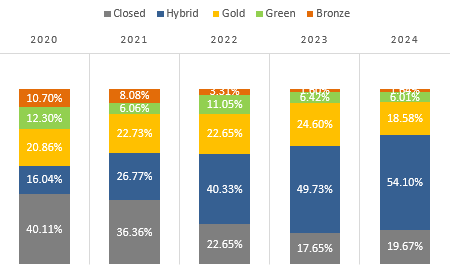
Since 2021, the Graduate Institute has agreements with major publishers that make it easier for researchers to publish open access (OA) articles. They have taken advantage of this opportunity and the proportion of OA articles has risen sharply. But a detailed analysis shows that the path taken may be unsustainable, and that most researchers are still neglecting simple ways to make their research accessible.
What colour is your open access?
This year, we have used the Unpaywall database to produce more detailed statistics on our publications. Instead of just distinguishing between open and paywalled articles, we can now also detail data on green and bronze OA articles.
Green open access is a simple way of making paywalled scholarly articles accessible to everyone. Journal articles are written by researchers who are paid by universities or research centres, not by the journals that publish them. Authors are often allowed to upload their accepted manuscript (i.e. ready for publication, with all corrections, but without the journal’s layout) to a non-profit repository such as their university’s. Some services such as Unpaywall or the Open Access Button then make it easy for interested readers to find these manuscripts whenever they don’t have access to the paywalled version.
The main issue with green OA is the embargo period defined by most publishers. They sometimes ask for 6 to 24 months before a publication is made available on a repository, which is incompatible with most funders’ policies. Some European countries have introduced a secondary publishing right, allowing to bypass such embargoes, but Switzerland has not. This is why the Swiss National Science Foundation requires its grantees to use the rights retention strategy to publish their accepted manuscript without an embargo. Ask your librarian how to include this provision in your future submissions to paywalled journals.
Bronze articles are freely available, but do not have a clear open licence. Open access articles should always mention a Creative Commons licence, which clearly states the permissions granted to the users. Bronze articles are technically free, but their status may change at the discretion of the publisher, who may decide to put them behind a paywall, which is why they are not considered “open access”.

2024 statistics: the Good, the Bad, and the Ugly
Good news, everyone! As you can see, the proportion of closed articles has fallen sharply in recent years, despite a small rebound in 2024. However, the paradox here is that if researchers were using the green route to open access, the proportion of closed articles should be close to zero, at least for 2020, 2021 and 2022.
More generally, we can see a sharp increase in hybrid OA. What is this, and why do librarians at the Graduate Institute have mixed feelings about it? Hybrid OA is when researchers publish OA in “hybrid” journals, i.e. journals with both OA and paywalled articles. This is typically what our “read and publish agreements” with major publishers make easy, and what our researchers love.
If we (and other Swiss libraries) had unlimited budgets, this could be fine, even though it arguably entrenches North-South inequalities. But in practice, these contracts are extremely expensive, since publishers are private companies that want to maintain their large profit margins. Negotiations are difficult, and in some cases the publisher’s unacceptable conditions cause no-deal situations, as is currently the case with Wiley.
This explains why national associations such as Swissuniversities (which designs the Swiss national OA strategy) increasingly see hybrid OA as a dead end. Read and publish agreements were originally intended to be “transformative”, leading to the transformation of hybrid journals into full OA journals, but we have to acknowledge that this is not happening and new solutions must be studied.
Interested in Open Science? You are invited! Come and join us for a cup of coffee (or of tea) at the Fab on Thursday, May 8th, from 9 to 10 am! We look forward to chatting with you!


One thought on “Open access publishing at the Graduate Institute: the 2024 barometer”