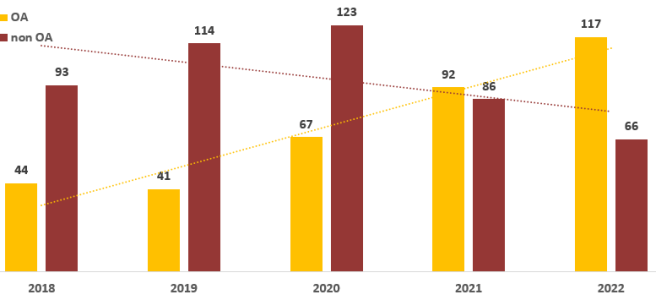
Since 2021, Geneva Graduate Institute researchers can fulfill their OA mandates easily and make their research more accessible through Read and Publish agreements with 6 large publishers. Most of them have jumped at the opportunity, and our research is now more open than ever before.
More Gold OA articles
In 2021, these agreements allowed the open-access publication of 45 articles. In 2022, we reached an amount of 57 articles, adding the four made OA retrospectively within the framework of our new agreement with Oxford University Press. The Taylor & Francis annual quota was higher this year, so it was only reached in October, compared to early July in 2021. In 2023, it will be even higher, so it might not be an issue anymore. The Library also funded three additional APCs (article processing charges) from its own budget for researchers who couldn’t fit into the quota.
These agreements are expensive, but they have helped making our publications more open. In 2020, 35% of the journal articles published by our researchers were open access. By 2022, the share of OA articles has risen to 64%. It should still be noted that such agreements come with their own issues: they tend to be implemented more easily in rich countries, perpetuating inequality between researchers with easy access to gold OA publishing and researchers who cannot afford it. Since OA articles have a citation advantage, this leads to an even stronger grip of rich countries on scholarly communications. Science certainly does not benefit from this situation.
The diamond route
To better understand how our researchers from the Graduate Institute publish open access, we have carried out a detailed analysis of the 110 open access journal articles published in 2022. 57 of these were published through our read and publish agreements, but this is not the only route taken by our researchers.
The open access landscape is rich and diverse, and diamond journals are an interesting alternative to the gold route. These journals are funded by universities, academic libraries, or research centres, and do not charge publication fees nor subscriptions – one obvious example being International Development Policy, a journal published by the Graduate Institute. They are a cheaper and fairer way of publishing OA, and we were pleased to see that some of our researchers are using them. In 2022, 22 articles were published in 16 diamond journals.
And the rest…
Our researchers can only use our Read & Publish agreements if they are the corresponding authors of the articles. Some of our researchers published OA articles as non-corresponding authors, and had to find alternate funding options. In 2022, 15 articles were published using funding from other authors, and the situation was much less clear for 16 additional articles, for which we do not know how the authors covered the fees. Is this really a problem? After all, they are available as OA… But the impact is more complicated than that.
Swiss universities do not know how many publication fees their researchers pay “in the wild”, to borrow a phrase in a recent report by Swissuniversities, but publishers do have this information. This creates an asymmetry of information that puts the Consortium at a disadvantage when they negotiate on behalf of Swiss academic libraries. It would therefore be better for us to know exactly how much is spent on publication fees each year by our researchers.
Authors wishing to find a suitable full open access journal for their article (with or without publication fees) can use a tool called Bison. If the gold or diamond routes do not work for you, you can still use the green route of self-archiving by uploading your accepted manuscript on the Graduate Institute repository! Catherine will be happy to guide you through all OA options.

