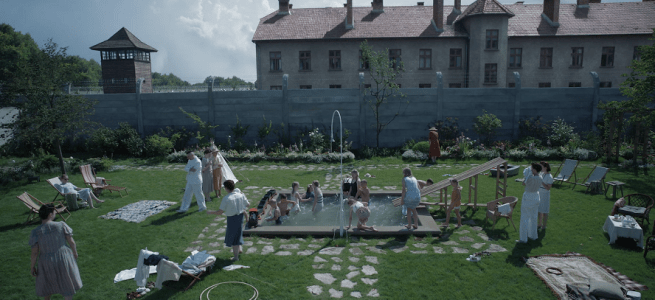
In 1943, the Höss family lived in a well-appointed house with a beautiful garden. Under their windows, the barbed wire of a concentration camp.
Sound precedes image: birds squawking, a metallic rage, vocalisations from deep within. The black screen is as insistent as the preamble to Michael Haneke’s The White Ribbon. Whispers rise in the audience to counteract the discomfort. Then, the sun illuminates the blond braids and half-naked bodies of the family by the water. Life seems so peaceful. The next day, after receiving his birthday present, the father, dressed in a Nazi uniform, leaves for work. A few metres away from the house, a reverse shot reveals the watchtowers of Auschwitz.
In 2015, Hungarian director László Nemes took us inside the gas chambers, placing his camera as close as possible to Saul, a Jewish prisoner in the Sonderkommando tasked with emptying them. The Zone of Interest could be its counterpart, with Jonathan Glazer choosing to film outside the chambers, without concealing the unthinkable. While the men discuss system improvements, the women bustle around salvaged clothes, laughing at a diamond found in a tube of toothpaste. In front of the mirror, the ruthless Queen Mother dons a fur coat she didn’t buy. Apart from a lining that needs sewing, it’s perfect. Sandra Hüller is chilling in the role, embodying the ‘anatomy of evil‘. Outside, the children cool off in the swimming pool as smoke from the train rises in the distance. In the bedroom, they play with teeth as if they were knucklebones.
In this paradise surrounded by hell, no one pays any attention to the daily screams, gunshots, and the lingering smell that the flowers of Eden try to mask. The background noise of the genocidal machine digesting burned bodies is also no longer heard. No ignorance or denial, only acceptance.
This underscores the impossibility of representing the Shoah in cinema. Extremely cold stills mark the distance to avoid any empathy with the executioners. The victims are never shown. The only tears shed are those of the baby, and the only ‘I love you’ spoken is to a horse. Using a thermal camera, a rather superfluous effect, we are told the story of a young resistance fighter. Once the witch has been imprisoned, Gretel sows apples in the hope of feeding those who are about to die.
In this context, the most insignificant details underline the horror of the situation: the curtains that could not be bought at auction, the ashes placed at the foot of the plants to embellish them, the Jewish girl who has to spread her legs. The discomfort is palpable, ruffling the hair and turning the stomach until vomit stains the steps of the headquarters.
On a razor’s edge, the director weaves a bold link to the present, reminding us that the banality of indifference is never far away. Today, Auschwitz is a necropolis that has become a place of remembrance and a tourist attraction.
The Zone of Interest by Jonathan Glazer can be (re)discovered on DVD at the Library.
Call number: 6.4.1 ZON
Film guide
Film collection
Don’t have a DVD player? Borrow a portable DVD player from our services.

 Geneva Graduate Institute Library Blog